
Executive Summary
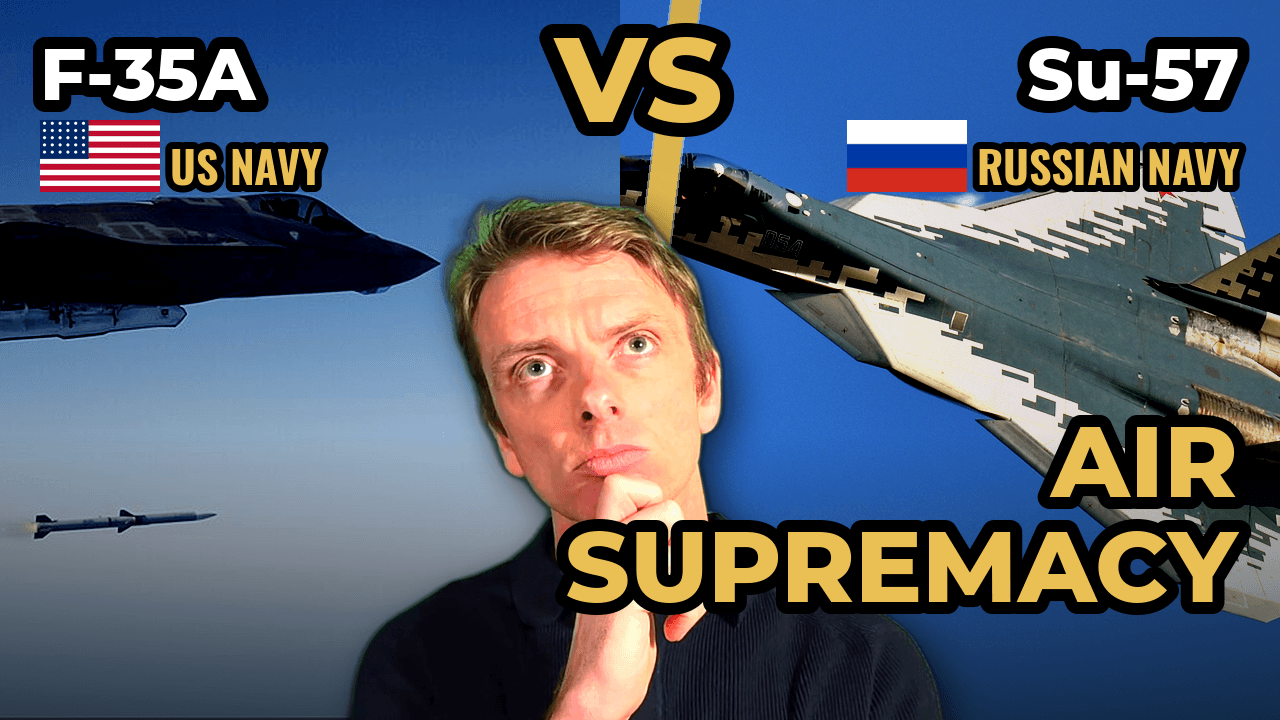
The comparison between the F-35A Lightning II and the Sukhoi Su-57 "Felon" is not a contest between equals. It is a study in the divergence of two military-industrial philosophies — one built on networked coalition warfare at scale, the other on platform-centric performance optimised for a nation that cannot afford the alternative. At a deployed ratio of approximately 36:1 (1,000+ F-35As to 28 Su-57s), the quantitative gap alone renders conventional platform comparison almost academic. The more instructive question is what each aircraft reveals about the strategic posture, industrial capacity, and doctrinal assumptions of its operator.
This assessment concludes, with high confidence, that the F-35A is the decisively superior platform in any realistic conflict scenario. The Su-57 retains niche utility in defensive air interception over Russian territory supported by ground-based sensor cueing, but cannot compete at theatre level. Its problems are not individual — they are systemic and compounding.
Iron Command Scorecard: F-35A 51/60 vs Su-57 31/60.
Head-to-Head Specifications
| Specification | F-35A Lightning II | Su-57 Felon |
|---|---|---|
| Max Speed | Mach 1.6 (1,200 mph) | Mach 2.0 (claimed)* |
| Service Ceiling | 50,000 ft | 65,620 ft (20,000m) |
| Combat Radius | ~670 nm (1,240 km) | ~675 nm (1,250 km) |
| G-Limit | +9g | +9g |
| Radar Cross Section | ~0.0015 m² (est.) | 0.1–1.0 m² (Western est.) |
| Engines | 1x P&W F135 (43,000 lbf) | 2x AL-41F1 (66,000 lbf combined) |
| Thrust-to-Weight | ~0.87 | ~1.02 |
| Internal Fuel | 18,250 lbs | ~22,000 lbs (est.) |
| Length / Wingspan | 15.67m / 10.7m | 20.1m / 14.1m |
| Cost Per Unit | ~$100M (with engine) | ~$42M (Russian accounting) |
| Units Delivered | 1,000+ (F-35A) | ~28 |
| Operator Nations | 20+ | 2 (Russia, Algeria) |
| Nuclear Capable | Yes (B61-12) | No (unconfirmed) |
*The Mach 2.0 figure is the design speed for the future Izdeliye 30 (AL-51F1) engine, which is not in serial production. With the current AL-41F1 engines — derivatives of the Su-35's powerplant — Western analysts assess the realistic maximum at Mach 1.6-1.8.
A common error in online analysis is the conflation of ferry range with combat radius. Numerous sources cite the F-35A's range as 1,200nm and the Su-57's as 1,944nm. These are maximum range figures, not combat radius. Combat radius — accounting for combat loadout, mission reserves, and return fuel — is approximately 670nm for both platforms. The operational reach of these aircraft is functionally identical.
The specification that matters most is one that rarely headlines comparison articles: Radar Cross Section. The F-35A's estimated RCS of approximately 0.0015m² — frequently described as "the size of a golf ball" — versus the Su-57's Western-estimated 0.1–1.0m² represents a detectability gap of 300x to over 600x. In practical terms, the same radar that detects the Su-57 at 150nm would not acquire the F-35 until approximately 25nm. The engagement is decided before the Russian pilot's sensors confirm a target exists.
1. Design Philosophy and Doctrinal Context
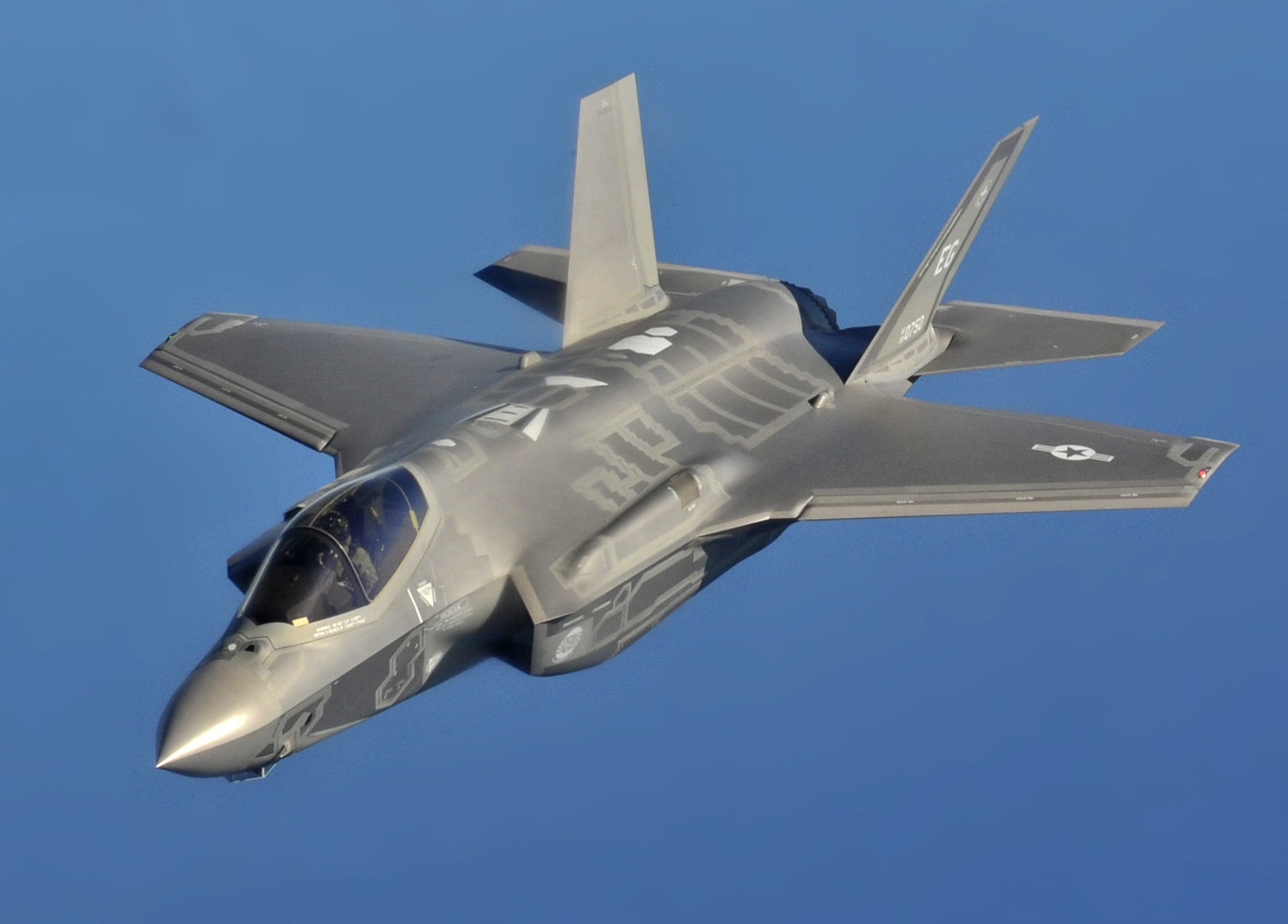
The F-35 emerged from the Joint Strike Fighter programme — the most expensive weapons system in history at $2.1 trillion lifecycle cost — with a singular mandate: replace the bulk of the Western tactical fighter fleet with a single, stealthy, networked platform producible at scale. The aircraft was designed not as a dogfighter but as a flying sensor node. Its value is multiplicative; each additional F-35 in a coalition force enhances the shared battlespace picture through the Multifunction Advanced Data Link (MADL), where a four-ship flight functions as a single distributed sensor platform.
This reflects the American theory of victory: information dominance wins wars. The pilot who sees first, shoots first. The force that shares data fastest, wins.
The Su-57 emerged from a fundamentally different strategic context. Russia's limited global satellite communications infrastructure means its combat aircraft cannot rely on the continuous networked guidance available to Western forces. The Su-57 compensates through raw performance — speed, supermaneuverability, and heavy payload — producing an aircraft capable of solving problems independently when data links fail or are jammed. This is not a design flaw; it is a rational response to a strategic reality. Russian doctrine necessitates a faster, more agile interceptor precisely because it cannot replicate the American networked ecosystem.
The programme has been capital-starved since India's withdrawal from the Fifth-Generation Fighter Aircraft (FGFA) joint venture in 2018. India had been committed to approximately half the development costs and over 200 airframes — a contribution whose loss left Russia bearing the full financial burden during a period of escalating sanctions and economic contraction. The consequences of this withdrawal are visible in every aspect of the Su-57's current operational status.
2. Stealth Architecture: Design vs Declaration
Stealth is the defining characteristic of fifth-generation air combat. Without low observability, the entire information dominance mission collapses — the aircraft is detected, tracked, and engaged before it can exploit its sensor advantages.
The F-35 was engineered for all-aspect low observability. Its serpentine engine inlet ducts fully mask the compressor face from radar illumination. Its surfaces are precision-milled with edge alignment across all panels. Its durable Radar Absorbent Material (RAM) coating is designed for field maintenance — unlike the fragile coatings of earlier stealth aircraft. The result is a platform where stealth is structural, not cosmetic.
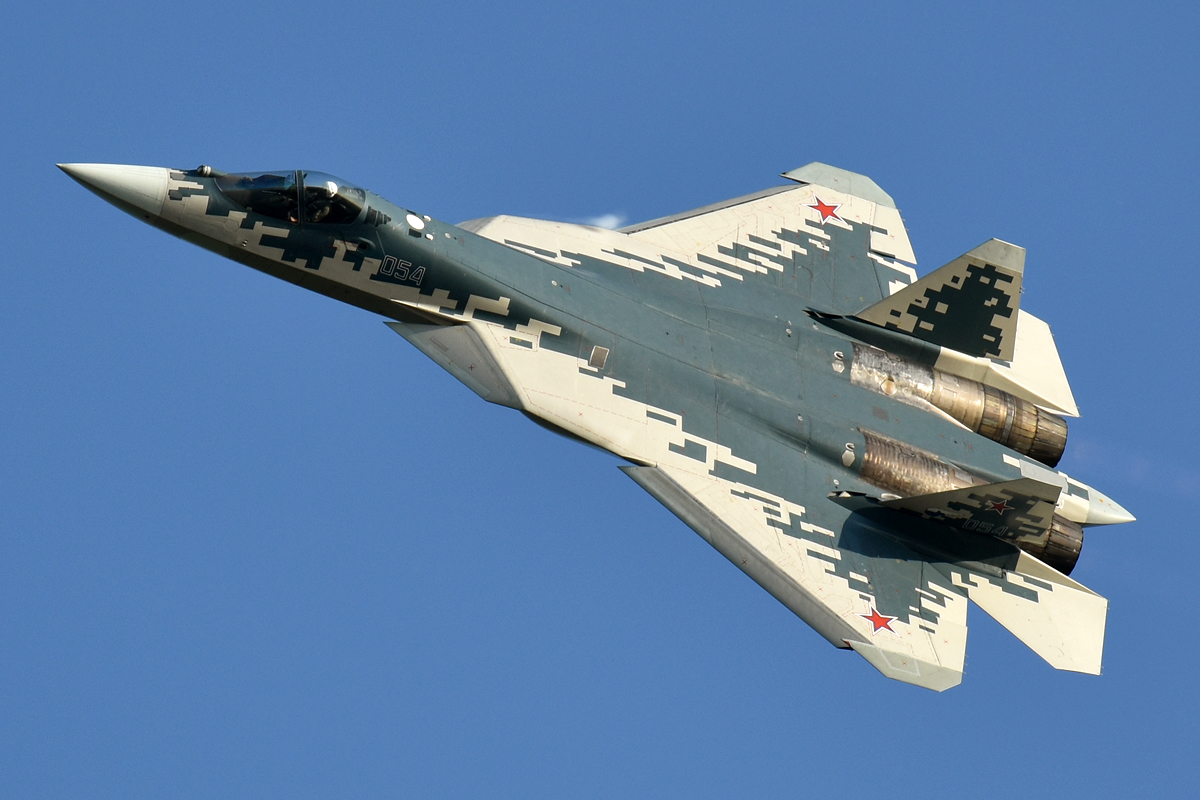
The Su-57's approach to low observability is more accurately described as selective signature reduction. Its design incorporates several features that fundamentally compromise stealth performance:
First, its engine nozzles are round (axisymmetric), not flat like the F-22's 2D thrust vectoring nozzles. These create significant radar and infrared returns from rear aspect. Second, its engine inlets are not serpentine — the compressor face is partially visible to radar, undermining the frontal signature the rest of the airframe attempts to minimise. Third, close inspection of production aircraft reveals visible panel gaps, exposed rivets, and manufacturing seams inconsistent with low-observable design standards. Fourth, the L-band radar arrays embedded in the wing leading edges — while serving as a counter-stealth measure against Western aircraft — are themselves radar reflectors at certain frequencies. Fifth, the wide spacing between engine nacelles creates a radar tunnel effect from lateral aspects.
Aviation Week described the Su-57's stealth characteristics as "stealth lite at best." Intelligence derived from the Indian FGFA programme — when India had access to Su-57 design data — reportedly informed estimates of frontal RCS at approximately 0.5m², comparable to a clean-configured fourth-generation fighter.
Iron Command Assessment (HIGH CONFIDENCE): The Su-57 is not a stealth fighter by Western standards. It is a fourth-generation airframe with partial low-observable features. The designation "fifth generation" as applied to the Su-57 is a marketing classification, not a technical description. It is most accurately categorised as a 4.5++ generation platform with fifth-generation aspirations — aspirations contingent on the Izdeliye 30 engine and mature avionics suite, neither of which is in serial production.
3. Sensor Fusion: The Invisible Advantage
The sensor suite comparison illustrates why specifications without operational context are misleading.
The F-35's AN/APG-81 AESA radar, with 1,676 transmit/receive modules, represents only one element of an integrated sensor architecture. The AN/AAQ-37 Distributed Aperture System provides six infrared cameras offering 360-degree spherical coverage — missile launch detection, aircraft tracking, and navigation FLIR simultaneously feeding the pilot's Gen III Helmet Mounted Display System (a $400,000 unit that fuses all sensor data into a single intuitive picture). The AN/AAQ-40 Electro-Optical Targeting System adds long-range target identification and laser designation from an internal chin mount, maintaining the aircraft's stealth profile without external pods.
The critical word is fusion. The F-35 pilot does not manage individual sensors. The system presents a unified battlespace picture. This is a generational capability leap: the difference between a pilot interpreting multiple screens and a pilot receiving answers.
The Su-57's N036 Byelka AESA system is not without sophistication. Its main X-band array, claimed to incorporate 1,552 T/R modules, is supplemented by two side-looking X-band arrays providing wider angular coverage than a single-array design. More significantly, its L-band radar arrays in the wing leading edges represent a specific counter-stealth measure — L-band frequencies can detect low-observable targets at ranges where X-band cannot. However, L-band resolution is insufficient for weapons-quality tracking, requiring handoff to the X-band array for engagement. The detection advantage does not automatically translate to a kill advantage.
The 101KS-N Atoll infrared search-and-track system enables passive detection — hunting without emitting radar signals that would reveal the Su-57's position. In theory, this allows the Felon to detect an F-35 via engine heat before its own radar emissions betray its presence. In practice, the system's production has been compromised by Western sanctions, with key supplier Mikropribor losing access to Western microchips. Reports indicate Su-57s have been delivered with incomplete sensor suites — a reality that renders specification-sheet comparisons particularly unreliable.
The AN/ASQ-239 Barracuda electronic warfare suite aboard the F-35 benefits from an advantage no Russian system can replicate: the NATO-wide threat library, continuously updated from electronic intelligence gathered across twenty-plus coalition nations. The Su-57's Himalayas EW system operates in isolation, lacking an equivalent collective intelligence network. Its effectiveness against Western electronic warfare environments is unverified.
4. Weapons and Combat Payload
F-35A Internal Loadout (Stealth Configuration)
| Weapon | Type | Range | Capacity |
|---|---|---|---|
| AIM-120D AMRAAM | BVR air-to-air | 180km | 4 internal (6 with Sidekick) |
| GBU-31 JDAM | GPS-guided bomb (907kg) | N/A | 2 internal |
| GBU-39/B SDB II | Small diameter bomb (113kg) | 110km glide | 8 internal |
| B61-12 | Variable yield nuclear | N/A | Internal |
| JSM (Joint Strike Missile) | Cruise missile | 555km | 2 internal |
| GAU-22/A 25mm | Internal cannon | N/A | 180 rounds, 3,300 rpm |
External "Beast Mode" additions: AIM-9X Sidewinder (35km, wing pylons, external only) and AGM-158 JASSM/JASSM-ER (370km / 925km, external only — too large for internal bays).
Su-57 Internal Loadout
| Weapon | Type | Range | Capacity |
|---|---|---|---|
| R-77M (AA-12 Adder) | BVR air-to-air | 190km | 4-6 internal |
| Izdeliye 810 (modified R-37M) | Long-range air-to-air | 200km | 2 internal |
| R-74M2 (AA-11 Archer) | IR-guided WVR | 40km | 2 in side bays |
| Kh-69 | Cruise missile | 290km | 2 internal |
| Kh-59MK2 | Cruise missile | 290km | 2 internal |
| KAB-250/500 | Guided bombs | GLONASS/TV | Internal |
| GSh-30-1 30mm | Internal cannon | N/A | 150 rounds, 1,800 rpm |
External additions: UMPK glide bomb kit (60-80km range, converting dumb bombs to precision glide weapons).
Two corrections are essential for analytical accuracy. First, contrary to widespread online claims, the F-35 cannot carry AIM-9X Sidewinder or AGM-158 JASSM missiles internally. The AIM-9X is external-only (wing pylons), and the JASSM is physically too large for the internal weapons bays — which is precisely why Norway developed the JSM as an internal-bay-compatible cruise missile alternative. Second, claims that the Su-57 can carry the Kh-47M2 Kinzhal hypersonic missile are unverified. The Kinzhal weighs approximately 4,000kg and measures 8 metres in length; it is a MiG-31 weapon, and no confirmed Su-57 integration exists.
The Su-57 carries a heavier and more diverse internal payload. The F-35 compensates with the Gen III helmet's high off-boresight capability — the pilot can lock and fire missiles at targets simply by looking at them, regardless of aircraft nose orientation. This partially negates the kinematic advantages of a more agile opponent in close combat.
The F-35A's nuclear capability (B61-12) makes it a strategic NATO asset that the Su-57 cannot match, extending its relevance beyond tactical air combat into the domain of nuclear deterrence.
5. Combat Record: Proven vs Theoretical
The F-35's combat record spans multiple theatres and operators:
- May 2018: Israeli F-35I Adir conducted first-ever F-35 combat strikes against Iranian Quds Force targets in Syria — the first fifth-generation fighter combat use in history.
- April 2019: USAF 388th/419th Fighter Wing deployed to Al Dhafra Air Base for first USAF F-35A combat strikes against ISIS in Iraq.
- January 2024: F-35As participated in strikes against Houthi targets in Yemen during Operation Prosperity Guardian.
- June 2025: F-35As from the 388th FW conducted SEAD missions during Operation Midnight Hammer, clearing the path for B-2 strikes against Iranian nuclear facilities — the first major peer-level suppression of enemy air defences mission for the platform.
- February–March 2026: F-35As and F-35Cs deployed during Operation Epic Fury against Iran. On 4 March 2026, an Israeli F-35I scored the first confirmed F-35 air-to-air kill against a manned aircraft (an Iranian fighter). On 19 March 2026, a USAF F-35A suffered the first confirmed combat damage from enemy fire (Iranian air defences) — the aircraft recovered safely, demonstrating combat resilience.
The Su-57's combat record is revealing for what it does not contain:
- February 2018: Two Su-57s deployed to Khmeimim Air Base, Syria. Russia initially denied the deployment, then admitted approximately ten sorties over two days. One Kh-59MK2 cruise missile was reportedly fired. This was a combat evaluation exercise, not a sustained operational deployment.
- 2022–present: Su-57s have been used for long-range missile strikes in the Ukraine conflict — launching R-37M AAMs and Kh-59MK2/Kh-69 cruise missiles at 200-300km standoff range from within Russian airspace. The aircraft has never entered contested Ukrainian airspace.
- June 2024: Ukrainian long-range drones struck Akhtubinsk airfield, 589km from the front line. Ukraine's military intelligence (HUR) confirmed two Su-57s were damaged, one significantly — the first confirmed strike on Su-57 airframes.
- October 2024: An Su-57 reportedly shot down its own S-70 Okhotnik loyal wingman drone over Ukraine to prevent capture after the drone lost control.
Iron Command Assessment (HIGH CONFIDENCE): Russia employs the Su-57 exclusively as a standoff missile truck, not as a penetrating stealth fighter. This operational pattern tells us more about Russian confidence in the aircraft's survivability than any specification sheet. Against Ukrainian air defences — which are considerably less capable than NATO's — Russia will not risk the Su-57 in contested airspace. The implications for a NATO scenario are self-evident.
6. The Production Gap: Where Strategy Meets Industrial Reality
The F-35 programme delivered a record 191 aircraft in 2025 alone — approximately 16 per month. Over 1,300 aircraft have been delivered across all variants to more than twenty operator nations. Three final assembly lines operate simultaneously: Fort Worth (Texas), Cameri (Italy), and Nagoya (Japan). The global supply chain involves over 1,650 suppliers across fourteen countries, with approximately 30% of components manufactured in Europe.
The Su-57's production trajectory is its most damning metric. Approximately 28-30 airframes have been delivered over six years, at a rate of 2-7 per year against a contract target of 22 per year. UAC ended 2025 without any officially confirmed new Su-57 deliveries. The sole production facility — KnAAZ at Komsomolsk-on-Amur — is the only assembly plant for the type.
On 11 April 2026, a fire broke out in Shop 46 (the polymer composites workshop) at KnAAZ. This single workshop produces approximately 300 composite part types for the Su-57, including roughly 100 large structural elements. The impact could halt production for months. No alternative production facility exists.
Western sanctions have compounded the industrial challenge. Key avionics supplier Mikropribor lost access to Western microchips. The N036 Byelka radar relies on components now sourced through Chinese grey-market channels at lower quality and reliability than the original Western parts. Reports indicate Su-57s have been delivered with incomplete avionics suites.
The F-35 programme produces more aircraft in a single month than Russia has built Su-57s in the programme's entire history. At a ratio of 36:1, individual platform quality is strategically irrelevant. The historical threshold at which qualitative superiority overcomes numerical disadvantage is typically cited at 3:1 to 5:1 force ratios. At 36:1, each Su-57 would need to be worth thirty-six F-35s — a proposition without historical precedent or analytical basis.
Algeria became the Su-57's first export customer in 2025, ordering twelve Su-57E variants for approximately $1.6 billion. While this validates the type as an export product, it simultaneously splits production capacity from domestic orders that Russia can barely fulfil.
7. Vulnerability Assessment
F-35A — Issues of Scale
The F-35's problems are real but are problems of success. Fleet-wide mission capable rates fell to 51.5% in FY2024, seventeen percentage points below the minimum requirement. Parts cannibalisation is endemic. The Block 4 modernisation programme is over $6 billion over budget and years behind schedule, with the TR-3 integrated core processor experiencing persistent stability problems. No combat-capable TR-3 aircraft were delivered through FY2025. Completion is now estimated for 2032, six years beyond the original target. The F135 engine's unit cost has surged to approximately $20 million, and the Engine Core Upgrade — selected over the more ambitious adaptive engine approach — is targeting fleet fielding no earlier than 2029.
Su-57 — The Death Spiral
The Su-57's vulnerabilities are not individual shortcomings but a compounding system failure. Its compromised stealth means it is detected first. Being detected first means it is engaged first. Its low fleet numbers mean every loss is catastrophic — losing two to three aircraft represents 7-10% of the entire fleet. Catastrophic loss risk forces defensive employment that negates any offensive advantage. The inability to operate offensively renders the production investment strategically pointless.
Iron Command Assessment: The F-35's problems are growing pains of a massive, funded, politically sustained programme delivering nearly two hundred aircraft per year to twenty nations. The Su-57's problems are existential: a technology demonstrator being produced at prototype rates by a sanctions-degraded industrial base, with its sole factory recently damaged by fire. These are not comparable categories of difficulty.
8. Scenario Analysis
BVR Engagement: F-35 wins 9/10. The stealth differential ensures detection and engagement advantage. The Su-57 pilot searches for a 0.0015m² target while the F-35 pilot tracks a 0.5m² target. The engagement is decided before the Su-57 pilot's radar confirms a contact.
WVR Dogfight: Su-57 wins 6/10. Superior thrust-to-weight, 3D thrust vectoring, and supermaneuverability provide genuine kinematic advantages in the merge. However, a fifth-generation fighter should never allow a merge — and the F-35's helmet-mounted high off-boresight targeting partially compensates even in close combat.
Sustained Conflict: F-35 wins decisively. At 1,000+ versus 28, the Su-57 fleet is attrited to combat irrelevance in days. Wars are determined by logistics, availability, and depth, not individual platform performance.
The Su-57's single viable scenario is defensive interception deep over Russian territory, supported by ground-based VHF radar cueing from systems like Nebo-M and Rezonans-NE. In this narrow context — home turf, ground sensor support, defensive posture — a small Su-57 force has genuine utility. This is the ceiling of its strategic value.
9. The China Factor
The most consequential observation in this comparison may be one that has nothing to do with the Su-57 at all. China's J-20 Mighty Dragon has entered service with over 330 airframes and is being produced at a rate of approximately 100-120 per year. RUSI projects 1,000 J-20s in service by 2030. China produces more stealth fighters in a single month than Russia has built in its entire Su-57 programme.
Both China and India walked away from joint stealth fighter development with Russia. The J-20's existence demonstrates that a non-Western nation can design, produce, and field stealth fighters at scale without Russian participation. The Su-57 has no viable export market against J-20/J-35 competition except to nations excluded from both Western and Chinese procurement channels.
Verdict
Iron Command Scorecard: F-35A Lightning II 51/60 vs Sukhoi Su-57 Felon 31/60
| Category | F-35A | Su-57 |
|---|---|---|
| Firepower | 8 | 7 |
| Sensors & Avionics | 9 | 6 |
| Electronic Warfare | 8 | 7 |
| Stealth & Survivability | 9 | 4 |
| Combat Record & Crew | 8 | 5 |
| Numbers & Logistics | 9 | 2 |
| Total | 51 | 31 |
The F-35A wins decisively. Not because it is a perfect aircraft — its maintenance rates are abysmal, its modernisation programme is over budget and behind schedule, and it costs more than it should. But the F-35 wins because it is a war-winning tool built at scale for coalition warfare. It excels at the mission that determines outcomes in modern conflict: stealthy precision strike and information dominance.
The Su-57 is a formidable dogfighter trapped in developmental and economic limbo. It is the right aircraft for a country that cannot afford the F-35 ecosystem — but 28 airframes with a damaged factory do not constitute a credible challenge to Western air superiority.
The real question this comparison raises is not "F-35 vs Su-57." It is whether Russia can remain a relevant air power at all. With China producing 100 J-20s per year and the F-35 programme delivering 190+, Russia's 2-7 Su-57s annually are strategically inconsequential.
The Su-57 is not worthless. In a narrow defensive role over Russian territory, supported by ground-based radar networks, a small force of Su-57s has genuine utility. But that is the ceiling of its strategic value.
As a symbol, the Su-57 represents Russian aerospace ambition. As a weapons system, it represents Russian industrial limitation. The gap between the two is the gap between aspiration and reality.
Sources: RUSI, IISS, GAO, Janes Defence, Lockheed Martin, Russian MoD (treated with scepticism), The War Zone, The Aviationist, Defence Blog, National Interest, Air & Space Forces Magazine, JAPCC, Army Recognition. All RCS figures are estimates from open sources — these values are classified for both platforms.
Pacific Brief
Get the next comparison in your inbox
Written intelligence assessments with analyst notes. Mon / Wed / Fri.